AI & Music Rights in 2026: Who Owns a Song Made with AI?
AI is changing music creation faster than the law can keep up.
From AI-generated beats to vocal cloning to fully automated composition tools, the question on everyone's mind is: Who owns the copyright?
As of 2026, the answers are still evolving-but here's what we know, and what you need to protect yourself.
The Core Legal Principle: Human Authorship
In the United States, the Copyright Office has been consistent on one point:
Copyright protection requires human authorship.
This means if an AI generates a piece of music entirely on its own, with no meaningful human creative input, that output is not copyrightable.
The AI didn't create it as a "work for hire." It's simply not protectable under current law.
The Grey Areas
1. AI as a Tool
If you use AI as a creative tool-like using an AI plugin to generate chord progressions that you then arrange, modify, and produce-the resulting work likely qualifies for copyright.
Why? Because YOU made creative decisions. The AI assisted, but human authorship is present.
Analogy: Using a sample library or a synthesizer preset. The tool provides raw material, but your arrangement and expression are original.
2. AI-Generated with Minimal Human Input
If you type "make me a hit song about heartbreak" and an AI spits out a complete track... who owns it?
Current stance: Likely no one. The Copyright Office has rejected applications where AI was the primary author.
The risk: Anyone could copy your "song" and you'd have no legal recourse.
3. Training Data & Your Music
Many AI music tools are trained on millions of copyrighted songs-including, potentially, yours.
The ethical dilemma: Should AI companies be allowed to train on your work without permission or payment?
The legal landscape: Lawsuits are ongoing. In 2025-2026, major labels and publishers sued AI companies for copyright infringement related to training data.
What you can do: Some platforms allow you to opt out of AI training. Check your distribution and platform agreements.
Best Practices for AI-Assisted Music
1. Document Your Human Contribution
If you use AI tools in your workflow, keep records of:
- What the AI generated.
- What YOU changed, arranged, or created.
- Your creative intent and decisions.
This documentation could be crucial if you ever need to prove human authorship.
2. Use AI as a Starting Point, Not an Endpoint
Treat AI outputs like rough sketches. The more you transform, arrange, and add your own creative expression, the stronger your copyright claim.
3. Be Wary of "Fully AI-Made" Claims
If a collaborator presents you with an AI-generated track and claims 50% songwriting credit... question it. Did they actually write anything, or did they just prompt a machine?
This is where SplitChord becomes essential-document who did what BEFORE you release.
The Label & Publisher Perspective
Major labels and publishers are increasingly cautious about AI content:
- Some refuse to sign AI-generated music.
- Others require artists to disclose AI use.
- Sync licensing clients (film, TV) may demand human-only compositions.
If your goal is commercial success, transparency about your creative process matters.
Future Legislation
Lawmakers around the world are debating AI and copyright:
- The EU AI Act includes provisions for transparency in AI-generated content.
- US Congress is considering legislation on AI training and copyright.
- The Copyright Office is refining guidance on AI authorship.
The rules will change. Stay informed.
Key Takeaways for 2026
- AI as a tool is fine. Human creativity still needs to be central.
- Fully AI-generated content has no copyright protection (currently).
- Document everything. Your creative contributions matter legally.
- Protect your catalog. Opt out of AI training where possible.
- Use SplitChord. Even in an AI-assisted session, documenting human contributions is critical.
The SplitChord Angle
AI doesn't change the fundamental need for split sheets.
If you and a collaborator use AI tools together, you STILL need to document:
- Who contributed what?
- Who owns the resulting composition?
- Who owns the master recording?
Ambiguity is your enemy. Clarity is your protection.
Get your splits documented-human or AI-assisted-before you release.
Keep Reading
DMCA Takedowns vs. Split Sheets - Why Filing a Takedown is NOT a Substitute for Handling Your Business
A DMCA takedown is not a magic button that gives you 100% ownership. Here's what the law actually says about copyright ownership, joint works, and why a split sheet is the only real protection.
The Legal Guide to Split Sheets: Why a Handshake Isn't Enough
What happens if you write a hit song but never signed a split sheet? We explore Copyright Law, Joint Works, and why documentation is your best defense.
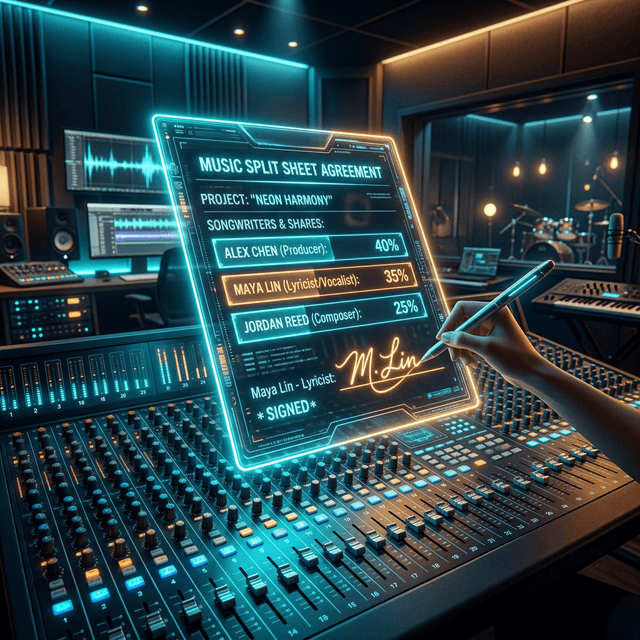
What Are Songwriting Splits? The Ultimate Guide on How to Divide Music Royalties
Everything you need to know about songwriting splits, how royalties are divided between lyricists and composers, and why split sheets are critical for your music career.
Protect Your Rights Today
Don't let split disputes ruin your relationships. Download SplitChord and get everyone on the same page before you leave the studio.